Action Model AI Employees: Build Workers That Earn
Action Model AI employees: build Actionist workers, earn up to 33% of the $LAM each run uses (locked by publish month), or resell for dollars. Oct 2026.

Start on Action Model with me
Three short steps. Action Model opens in its own tab while this step stays pinned here, so you come back and tick it off.
- 1Open Action Model and sign up · 5 min
- 2Do the first real task · 5 min
- 3Come back and set it as a habit · 2 min
The full guideRead the full write-upEvery step, fact and link
Action Model AI Employees: Build Autonomous Workers That Earn
Most people farming Action Model treat it as an extension you leave on. The bigger opportunity is being the employer, not the trainer.
As of October 2026, Action Model's 350 million $LAM community pool (35% of supply) is published but $LAM has no TGE date, and its marketplace already pays creators when their workers run. Under the points and the extension sits a business: build autonomous AI workers, publish them, and earn every time someone else runs one. Start on Action Model.
What changed recently: Actionist now has its own commercial home on the Actionist site, sold in US dollars ($55 a month Basic, $155 a month Pro), with a reseller partner program for agencies. The $LAM creator model still lives in the Action Model docs. So there are now two ways to get paid as an employer: $LAM from marketplace runs, and dollars from clients. More on both below.
One detail most guides miss: the creator cut is not a flat 33% forever. It is locked to the month you publish, and it falls to 5% by month 9. Timing is the edge.
What are Action Model AI employees?
Action Model AI employees are autonomous workers built with Actionist, Action Model's desktop app, that perform real tasks across software from a plain-language description. Action Model is the brain, a Large Action Model that learns how software works. Actionist is the hands. You describe a task, no code, and it executes. It runs in two modes:
- Personal Assistant: drives your local machine.
- Cloud VPC: a cloud VM that works 24/7 without your computer on.
Data entry, multi-platform workflows, scheduled automation, and memory that carries context between tasks: the boring digital labour, done by a worker that never sleeps.
The docs add the practical detail. Actionist runs on macOS 10.15+ and Windows 10+ (Linux is listed as coming soon). Local mode is free to start but takes over your mouse and keyboard, so you cannot use that computer while it works, and it runs one agent at a time. Cloud VPC gives each agent its own Mac or Windows virtual machine, so several agents can run in parallel, billed per cloud instance. Setup asks for three permissions: Screen Recording, Accessibility and Network Access. Every run is logged with action history and video playback, which is your audit trail. (Actionist overview)
On the Actionist site the same product is pitched as AI employees by role: Lead Generation Agent, Bookkeeper, Support Agent, Recruiter, Inbox Manager, SEO Expert and around two dozen more. The loop is Describe, Plan, Act, Approve, Repeat, and its App Store lists 860+ integrations.
How do you earn as the employer?
You earn on Action Model by publishing workflows to its marketplace and taking a share of the $LAM consumed every time they run. The pieces:
- Build once, earn on every run. Every action an AI takes burns $LAM as fuel, and up to 33% of that goes to the creator of the workflow it ran, depending on the epoch it was published in. Popular automations become passive income.
- Sell AI employees as a service. KOLs and agencies have clients who need repetitive work done. Package Actionist workers, lead handling, reporting, cross-posting, and earn from every workflow those clients run. Agency work where labour scales without hiring.
- Stack it on the airdrop. Building sits on top of the confirmed community allocation , not instead of it.
The people who get rich in the agent economy will be the ones who employ agents, not just use them.
How is the Action Model creator share calculated?
Action Model splits every $LAM consumed by a marketplace workflow three ways: up to 33% to the creator, 34% burned and 33% to the ecosystem, according to its token utility docs. The 33% is the top rate, not the only rate. Each workflow is tagged with the Creator Epoch it was published in, and that rate is locked permanently. The published schedule:
- Epoch 1 (month 1): 33%
- Epoch 2: 25%
- Epoch 3: 20%
- Epoch 4: 17.5%
- Epoch 5: 15%
- Epoch 6: 12.5%
- Epoch 7: 10%
- Epoch 8: 7.5%
- Epoch 9 and later: 5%
The docs put it plainly: a workflow published in month 1 earns the full 33% in perpetuity. The marketplace page still marks Builder Epoch #1 as active, but check which epoch the app shows on the day you publish, because that number is yours for the life of the workflow.
What a run actually pays. The docs price LAM-1 at $0.01 per action in USD, with the number of tokens floating against the $LAM price (one formal section says $0.10, so the docs are not fully consistent). At $0.01 an action and the 33% rate, a 50-step workflow run 1,000 times a month is 50,000 actions, about $500 of fuel, and roughly $165 of that to the creator (the other 67% is burned or goes to the ecosystem). That is arithmetic on the published rate, not a promise: the marketplace's own income projections come with no method behind them, so I would ignore them.
Where demand is pointed. The marketplace shows bounty multipliers by platform, higher where commercial value is higher: Stripe 73x, AWS 15x, QuickBooks 12x, Shopify 10x, GitHub 10x, TikTok Business 7x, Instagram Business 5x, Slack 2x, Gmail 1.2x. The docs do not say what a multiplier converts to in dollars, but they are a clear map of where Action Model wants workers built. Workflows can be linear or complex (chains, loops, IF/THEN branches, variables, error handling), and an Ask Human option pauses a run for your approval at critical steps. (Marketplace overview)
Can you earn in dollars, not just $LAM?
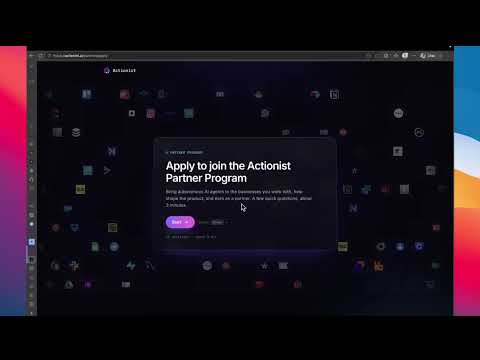
Yes. Actionist's partner program pays resellers recurring revenue share for every month a client keeps using Actionist. It is aimed at agencies, consultants, freelancers and automation builders, applying is free, and partners work inside client accounts through a Partner Dashboard without seeing client passwords. The page does not publish a commission rate; its calculator uses an example of a $300 monthly fee per customer and $120 a month in revenue share, so treat that as an illustration. You can also earn on partners you refer.
This is the part that makes "sell AI employees as a service" concrete. The client pays you a setup or management fee, Actionist pays you a recurring share, and if you also publish the worker on the marketplace, every outside run pays $LAM. Three revenue lines from one build.
What the plans cost the client (pricing): Basic is $55 a month (1 seat, 5 active agents, 1,000 Reactions, cloud runtime and computer use); Pro is $155 a month (2 seats, 20 active agents, 5,000 Reactions, Projects, 10 hours of cloud browser), with extra seats at $10 a month. The pricing page does not mention $LAM.
Why this is a real builder frontier
Action Model gives you the two hard parts: an AI that can operate software, and a marketplace that meters and pays for usage. What is missing is the imagination layer, the specific workers nobody has built yet:
- reporting bots for a niche SaaS
- onboarding flows for an agency's clients
- research-and-summarise employees for KOLs
- cross-posting workers for creators
Each is a product with a payment rail built in. It is the same shape that rewarded early builders on Bankr and in the Virtuals agent economy : a paying marketplace that arrived before the crowd.
How does Actionist compare with other agent marketplaces?
Actionist's difference is computer use: per its learning docs, it can operate apps that have no API, while still plugging into any MCP-compatible server (Slack, Notion, Linear and Stripe are the named examples). API-only automation tools stop where the API stops; Actionist keeps going through the screen. The other agent markets I cover pay differently. Virtuals pays agents for jobs, Bankr is onchain-first with pay-per-call Skills, and Pond and OKX.AI are building task markets where agents bid for work. Action Model is the one aimed at ordinary office software, which is where most paid repetitive work still lives.
What I'd build first
If I were starting today, I would pick one repetitive task I already do weekly, build the smallest worker that does it, use it myself for two weeks, then publish it. A worker you rely on is a worker others will pay to run.
Step by step, cheapest first:
From idea to shipped business
Spotting the gap is the rare skill; the building has scaffolding. If engineering outpaces you, Deployr can build it (start here ). Grow it into a business, and go after grants and funding, through ceoism ; the playbook is grants and VCs for web3 builders , and builder-side drops are in developer airdrops and grants . New to agentic AI? Start at web3wikis.
Build it: a creator dashboard for Action Model builders. Track each published workflow's Creator Epoch, run count and estimated $LAM earned at the $0.01-per-action rate, and flag which bounty platforms nobody has covered yet. Every builder on the marketplace would use it. Ship it with Deployr .
Is building on Action Model worth the risk?
Building on Action Model is worth it if you build for the product first, because creator earnings are paid in a pre-TGE token of unknown value. The marketplace, creator economics and agent reliability are still maturing, so you are betting on trajectory. Workers that operate real software need careful permissioning: know exactly what a worker can touch, and start with low-stakes tasks.
The specific risks I would weigh:
- The rate decays. Publishing late means 5%, not 33%, permanently. Waiting for a "finished" product costs you share.
- The docs disagree with themselves. Creator share appears as both 30% and 33%, and the per-action price as both $0.01 and $0.10. Build on the lower figures.
- Two products, two economies. The dollar subscription on actionist.ai does not mention $LAM, so do not assume client subscriptions generate marketplace fuel for you.
- Your machine is the worker. Local mode needs screen recording and accessibility control. Use a dedicated machine or Cloud VPC for anything touching client accounts.
Stack it
- Action Model airdrop guide : passive extension, ActionFi tasks and the partner program.
- ActionFi third-party campaigns : real tasks that pay in partner tokens and $LAM.
- Physical AI: the builder frontier : the next agent market after software.
- What is a Large Action Model : the concept under all of this, and the Action Model entry for status.
Action Model builder FAQ
How do I earn from building on Action Model? Publish a workflow to the Action Model marketplace; you earn up to 33% of the $LAM consumed each time it runs, set by the Creator Epoch you publish in and falling to 5% from epoch 9.
Is the 33% creator share permanent? It is locked to the Creator Epoch you publish in: 33% in month 1, then 25%, 20% and down to 5% from month 9 onward, per the Action Model docs. A workflow keeps its rate for life.
Do I need to code to build an Action Model worker? No. You describe tasks in plain language in Actionist; for anything beyond that, Deployr can build it for you.
When is the $LAM TGE ? Action Model has not announced a $LAM TGE date as of October 2026; the 350M community allocation is published.
How do agencies and KOLs use Action Model? They package AI employees as a service for clients and earn from every workflow those clients run. Action Model also runs a private Creator Circle for content creators.
How much does Actionist cost? Local Actionist is free to start; actionist.ai lists Basic at $55 a month and Pro at $155 a month, and Cloud VPC is billed per instance.
Can Actionist run when my computer is off? Yes, in Cloud VPC mode it runs on a cloud VM 24/7.
Related: Action Model airdrop guide , Action Model ambassador network , developer airdrops and grants , the planner , the October 2026 airdrop roundup , all airdrops .
Research, not financial advice. Web3 carries risk, do your own diligence.
Developer airdrops reward builders. Ship a real app and contract with Deployr, or cross over to ceoism, evolve into a founder, and go after grants and VC funding. Can't build it yourself? Deployr can build it for you.
More field notes
New to web3, or want the bigger picture beyond airdrops? Explore web3wikis - how it works, why it matters, and what you can do with it.
Research, not financial advice.